Week 4: Words, words, words. Yadda, yadda yadda.
Or how it's all about the way you tell it....

This week I have been following the tutors’ advice to read the scripts of my favourite films. If you want to be a successful screenwriter you have to read a lot of scripts. Obvs. And there is something about seeing the words on the page that is quite amazing because, unlike plays, which are open to interpretation, film and television scripts can be quite prescriptive in relation to matters of performance.
There are many stages in the process from ‘pitch’ to ‘production’ and at each stage there may be different versions of the script with varying degrees of direction. During the production of a film the script moves towards becoming a shooting script which will include directions for the actors and crew. Convention has it that the scripts are printed on different coloured paper, changing from ‘white’ through blue, pink, yellow and so on (Set Hero). But these days the paper itself might not actually be coloured… but the script will be labelled as having a colour and the order of the colours identified so that people know which version they have in their hands.
Sometimes, as we know, the published ‘script’ is written after the film has been made and so might be a long way removed from the writer’s original intention. The film script as a publishing phenomenon is pretty new, unlike play scripts which have been a flourishing publishing business for some time. And every time a play is performed it will be quite different — which is why when I saw Andrew Scott perform Hamlet, I was in floods of tears by the end. Even though I do, of course, know the story. I knew it would not end well. But, hey, that man can act. And I blubbed.
Succession (dir. Mike Mylod; writer: Jesse Armstrong)
So I (quite legitimately) got hold of the ‘Full Blue Production Draft’ of ‘All the Bells Say’ Episode 309 of Succession by Jesse Armstrong. I know, pretty cool, ay? This is the season closer, following the watery ‘rebirth’ of Kendall Roy (Jeremy Strong) when he survives potential drowning and we see how he is integrated back into the family. On reading this version of the script I was gobsmacked by how much direction is written in the script as the three Roy siblings gradually coalesce to make their vicious, but ultimately frustrated, bid to oust their father, Logan (Brian Cox). Take the direction between these couple of lines between siblings Shiv (Sarah Snook) and Roman (Kieran Culkin) when their brother Kendall’s car pulls up presaging his arrival early in the scene:
SHIV: Okay, here he comes, nice, yeah?
Roman looks like, well, yeah, I’m not a monster. But them mumbles, because he can’t stand the sonorous atmosphere:
ROMAN: Kurt Cobain of the fucking floaties.
Now, Kieran Culkin has proven what a terrific actor he is and how he relishes this juicy role. The character says more in looks and gestures then in words but also he can’t bear a silence so he’s always the one to chip in with a snide remark or a shitty put-down. But how much of the direction ‘Roman looks like, well, yeah, I’m not a monster….’ was in the ‘white’ script and how much was added during rehearsals summarizing what Culkin is doing with the line? Tell me, Kieran? Jesse, please? In this version of the script there are several notes which indicate what characters are thinking; or that draw our attention to a subtext; or has nuance for a different story arc. The final line of the script reads:
Tom heads on in to find the three siblings together. A hand held here. A bit of support there. Broken but together.
This triumvirate has been forged in an alliance which pitches them against their own father but also the rift between Tom and Shiv has widened; the relationship between Roman and Gerry has fractured; and Logan and Kendall are further apart than ever. The dualistic pairings which provide the dynamic for the story have been restructured and while the attention of most of the script has been on Kendall, Shiv and Roman, it is really their individual relationships with the wider business/family that is going to form the main part of the narrative for the next season. Maybe. Because this episode is a call to battle in the guise of a family reunion. And this ‘blue’ draft has quite a lot of direction on it and some descriptions of how lines should be delivered. So, my question is: how much of this was put there by the writer, Jesse Armstrong and how much was added in rehearsal or as the actors got into their roles? Let me know in the comments below if you know or have a hunch…
The Bad Lieutenant (dir. Abel Ferrara; script Abel Ferrara and Zoe Lund)
This week I also read the script of one of my very favourite films, The Bad Lieutenant (dir. Abel Ferrara, 1992) and I gotta tell you, reading that script was an absolute revelation. It is unrelenting just how bad that lieutenant really is when you see it on the page. He just keeps on doing one bad, shitty thing after another. He is an absolute devil and yet, Harvey Keitel plays him like he’s an angel.
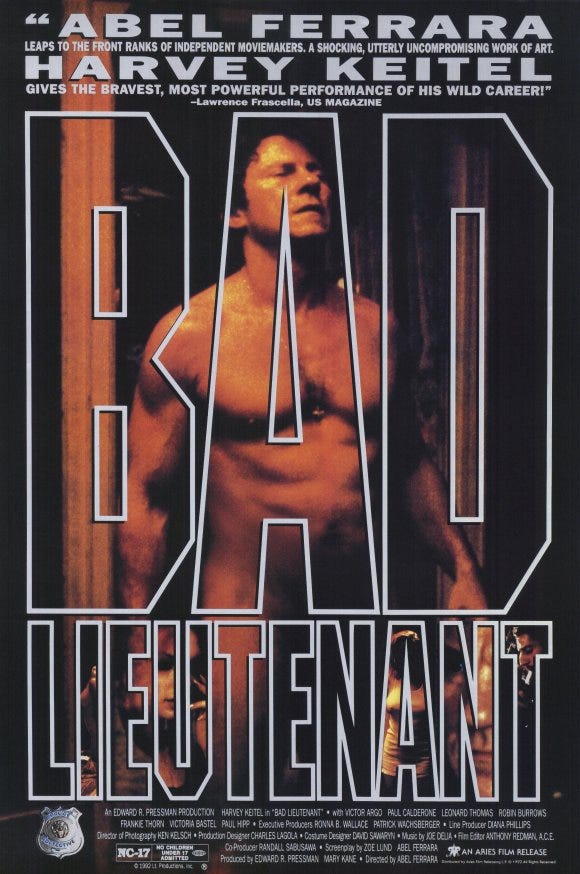
So that’s what I have been thinking about as I have been reading these terrific scripts: the power of the performance. Because Bad Lieutenant is undeniably a terrific script, but there is something about Keitel’s acting that takes the whole project to another level. And so far on the course we have talked about whether the director or the writer are the real ‘auteurs’ (yadda-yadda) but I defy you to watch this film and not say that Harvey Keitel has created a work of genius. Some actors create magic from taking the words that we screenwriters have crafted and transporting them to another level with the way they use their bodies; their voices; their movements and their muscles. And when the film is released, the performance is there, locked in. It happens in Succession; it happens in Bad Lieutenant and it happens in pretty well any great production.
As screenwriters we have to have some humility about that because, Jesus, when it works, it really works. So this week has taught me that I have to write stories and dialogue that the best actors in the world will be fighting each other to play.
In the final cut, whoever is the ‘auteur’
the actors are the stars.
Let me know what you think. And, have you read any good scripts lately?
I read this with great interest. The question posed by you is who is/are the real star/s - the screenwriter, the director or the actors?
I love your angle of how a great actor can ‘grow’ the script and evolve it to something very powerful (Hamlet example) and I have to agree. Conversely, a great script can be ruined by poor acting! I also believe that the writer’s writing is the original inspired work of art, and that, without good writing I’m not sure a great actor can make the script great. One of my faves is The Godfather Trilogy. For me we have the classic triad of woven skill in Puzo’s writing, Coppola’s direction and the likes of Pacino, Brando and Diane Keaton making it an all time Great.